


Thursday 27th February Liz Crudgington Head of News from the Herne Bay Times came into school to meet the Year 9 pupils involved in the Football and Peace project. Please see the full article in the Thursday 6th March edition of the paper p.22.

During the visit she spoke to the pupils about their experiences with the project and looked at the work they had produced.
Copy of the article to follow.
9S1, Monday 23rd February 2014 had the pleasure of welcoming Professor Adrian Smith from the University of Southampton to teach their usual period 5 History lesson.
Professor Adrian Smith was invited into the school as part of the organisation www.speakers4schools.org to speak to the class about the role of football in World War One. He spoke of the role of football and other sports such as rugby and cricket in recruiting men into ‘Pals Battalions’ to fight on the Western Front. He also discussed the Christmas Truce and debated whether there were football matches taking place during this temporary cease fire in 1914, never to be repeated during the rest of the war. To read more about Professor Smith please go to: http://www.speakers4schools.org/speakers/professor-adrian-smith

Professor Smith was also joined by Ernie Brennan, the director of the National Children’s Football Alliance. Ernie filmed the whole lesson as part of the Football and Peace project to commemorate the centenary of World War One which ten pupils in this class are part of.
Professor Smith emailed the school after the event and said “Thank you for giving me the opportunity to speak to your class. I thought they were terrific, both bright and well-behaved”
Conscription
Conscription is where if you where between the ages 18-41 your name was put in a sort of raffle and random names where chosen.
If your name was picked you would receive a calling letter telling you that you have been chosen and that you have to go to your nearest recruitment point

The role of Lord Kitchener
Kitchener was a British military leader, as he was secretary of state of war in the first years of World War One, he would organise armies, Kitchener was also responsible for the military strategies
He was also on the most famous British army recruitment poster ever produced.
Munitions workers
Women started working in factories when men where away fighting .because their wasn’t enough men to work, women would make metal, aircraft wood work, bullet and shell making. The chemicals that the women where working with was very dangerous, in fact because of the sulphur in the gunpowder their skin would turn yellow giving them the name canaries

DORA
DORA means defence of the realm act
This is a law that the government presented in 1914, these where things that citizens where not aloud to do
For example
-No-one was aloud to ring church bells
-Beer was to be watered down
-The government could take over media
-The government could take over land
-No bonfires or fireworks
-No-one is aloud to buy binoculars
-No rumours about the war
-No-one was aloud to melt silver or gold
-customers in pubs where not aloud to buy a round of drinks
– opening hours in pubs where
White feather campaign.
The white feather campaign was introduced by Lord Kitchener (see page two) in 1914. This campaign was where women (of all ages) would patrol the streets/shopping centre humiliating men they thought should join the army. The women would hand out white feathers (a sign of cowardice) to men that were fit to join the army. For the men this would be very embarrassing so they would join up straight away. A few women would also hold up signs with writing on them.
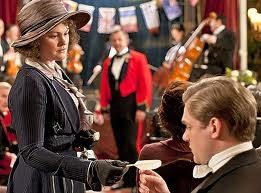
Pals battalion.
This was a method of increasing the amount of men joining up. Lord Kitchener introduced this method in 1914. Pals battalion was where a group of men e.g. football teams, cricket teams, choirs, etc would join the army/war as a group. The advantages of being part of pals battalion was that you were with people you knew/friends, the war was more enjoyable you would not need to make friends , the atmosphere would be a little more enjoyable. The disadvantages were… unfortunately if you were attacked you may see your friends die, get injured, get shell shocked, be in agony! Etc you may loose hope and there sprits would decrease rapidly, groups of people would die together , you may quarrel with a friend and not be able to sort things out… Pals battalion was soon gone because less and less men were joining the army/war voluntarily this was because friends and relatives were seeing each other getting slaughtered. (Lenham had quite a few pals battalions)
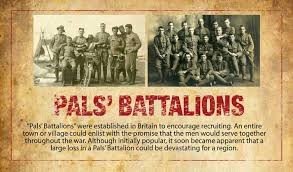
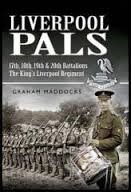
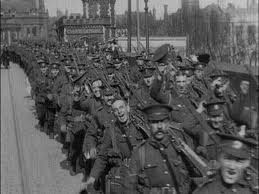

FOOTBALL TEAMS
The government encouraged women to take part in sports like football, so they would stay fit and healthy whilst at work. Football became the official sport of Munition Workers, nearly every factory across Britain had a women’s football team. Women played football to raise money for charities that help wounded soldiers. Women were encouraged to play football so that the country could act as if the war was not happening.
Women did not wear a football kit; many wore a loose fitting blouse and long shorts, as well as knee-high socks. Some teams that could not afford to buy long shorts or blouses, had to use what they had. Some wore knickers instead of shorts, which was frowned upon by the Football Association.
The Football Association tried to get rid of Women’s Football as they thought it would become more popular than men’s. However, when the war ended and the men returned, men’s football became popular again and women’s was overshadowed.
Dick Kerr factory in Preston was said to be the best football team in the country during the war. They played across the UK as well as going abroad to Holland and France. A more local team is Crabble Mill Dover, which was one of the best in Kent.
Competition during ww1
English club Harrogate town were due to play their first ever match on 5 September 1914, but the match was cancelled due to the outbreak of the war.
Between 1915 and 1919 pro football was called off in England. Many footballers signed up to fight in the war and as a result many teams were depleted, and played guest players instead. Many teams joined the forces and made pals battalions there were a lot of sport team based battalions during the war but these were split up after they stopped allowing pals battalions. The first of the footballers pals battalions was formed in Edinburgh in November 1914 by a man called Sir George McCrae. The 16th Royal Scots included players and supporters from Hearts, Hibernian, Falkirk and Raith Rovers, and recruitment of 1350 officers and men was completed in only six days.
Walter tull
Walter tull was an English professional footballer who played as an inside forward for Tottenham Hotspur and Northampton Town. He was the second person of mixed race to play in the top division of the Football League, the first mixed race outfield player in the top leauge of English football, and the first to be singed up as an infantry soldier in the British Army. His pro football career began after he was spotted whilst playing for his local club, Clapton FC. He started playing for Clapton in 1908 and within a few months he had won medals in the FA Amateur Cup,Walter Tull was brought up in an orphanage in
London, along with his brother, after the death of their parents. He joined Tottenham in 1909, and moved to Northampton Town in 1911, where he made 111 first-team appearances.
During the First World War walter Tull served in both Footballers Battalions of the Middlesex Regiment, 17th and 23rd, and also in the 5th battalion, getting to the rank of sergeant and fighting in the Battle of the Somme in 1916. In may 1917 he became the first black combat officer in the British Army, despite his race and coulor.He was killed in action on 25 March during the Spring Offensive, near the village of Favreuil in the Pas-de-Calais.
Conscription
Conscription was introduced in 1916 due to the lack of men joining the front lin. The number of soldiers weren’t high enough, so the British government had to do something.
Conscription led to people becoming conscientious objectors (c.o’s or conshies). Some of these people would go to war as doctors or ambulance drivers, where as others completely refused to go any where near the war.
There was nearly 20,000 c.o’s in all, most had settled for non-fighting roles in the army but, about 1000 others refused to have anything to do with the war.
Conscription is a law which stated that any man aged between 18 and 41 could be forced to join the army if their name was randomly selected.
Before conscription was introduced the government used a national register of all men between the ages of 15-65 and the derby scheme, this was introduced to ask men to promise to sign when needed. This didn’t work because when the men where needed they just said that they’d changed their mind.
Christmas day truce The Christmas truce was an unofficial truce between the soldiers fighting on the front lines in the western front during ww1 ,World War One had been on for several months but German and Allied soldiers got out of their trenches, and agreed a truce so the dead could be buried. The soldiers also used that truce to to eachther and it is believed even play a football match. Unofficial truces between opposing forces occurred at other times during World War One but never on the kind of levelof the first Christmas truce.
DORA |
DORA stands for the Defence of the Realm Act. DORA allowed the government to control Britain whilst at war. DORA put restrictions on what went into the newspapers, only putting positive reports so Britain’s moral was kept high. If negative stories were shown the countries moral would be affected and it would prevent men from signing up.
The government controlled certain parts of British Citizens lives allowing them to take over any buildings, land or factories. As well, the government took over any businesses or industries affecting the war. DORA allowed the government to control the way people lived their lives in Britain as they were trying to keep the country clean and tidy whilst Britain was at war. DORA allowed pubs to water down beer so it wasn’t as strong. The government introduced British Summer Time allowing people to work longer hours.
Chapter two
Dora stands for The Defence of the Realm Act; it was introduced by the British Government in August 1914. This gave the Government a lot of power; they could choose what the public heard or read, imprison people without trial, take over the economic resources for the war effort and place numerous restrictions on a citizen’s life.
The Government wanted the people to think that the war was going well, they did not want anyone finding out about all the losses that had happened on the western front, so to make sure no one heard about it the government: could not talk about Navel or military matters in a public place, newspapers could only report good things about the British army and bad things about the Germans and free speech also became a victim of DORA.
When the men had to leave to join the army, the women had to take all the men’s jobs, to keep Britain going. Most of the women got jobs as: Nurses, teacher, drove ambulances and some even became policewomen. But most of them went to work at munitions factories, the reason for this is that some women wanted to help there: Husband, brothers or sons, there is another reason why women went to the munition factories is that the pay that you get was better than all the other jobs.
Munition factories made a lot of things for the men in the army: Clothes, food supplies and the most dangerous thing they made was ammo and bombs. The munition factories were not as good as they sounded the chemicals of the bombs were every harmful to your health.
In Britain the women decided that they wanted to help the men, so they decided to make a women’s land army, they decided to dothis as in Britain they only had 6 weeks of food left in Britain as the Germans were bombing the English food supplies. The women’s land army was were they worked on farms, to produce food for the shops and people in Britain, this is also why rationing was introduced.
When the men went off to the war, the women decided that they wanted to play football. They took to the pitch to keep football fans’ spirits high while Britain’s men were off at war. There was one women team that was very successful, the Blyth Spartans Munitionettes from Northumberland played more beautifully than all the others.
Their star centre-forward was Bella Raey, the daughter of a local coal miner, who scored 133 goals in one season, and even went on to play for England.
The highlight of the female football calendar was a knock-out tournament called the Munitionettes Cup, held in 1918, which attracted 30 teams.
The Blyth Spartans were the eventual winners, beating Bolckow-Vaughan of Middleborough at Acrosome Park in front of a crowd of 22,000. Bella Reay scored a hat-trick.
Taught to play by naval ratings on a local beach, the Blyth Spartans remained unbeaten throughout their two-year existence.
But despite the women being almost as popular on the pitch as the men had been before the war, when the boys returned home, the munition factories closed and the teams disbanded.
Several women tried to continue to play, but in 1921, the FA banned women’s football at their grounds – bringing to an end a colorful chapter in women’s sport which has long been overlooked.
During World War 1 Britain declared a Blockade of Germany responded with its own U-boat Campaign (World War I) to sink ships carrying military equipment or food to Britain. Food becoming more important as the war continued, especially after the declaration of unlimited U-boat warfare. In about two years, the United Kingdom had just six weeks’ food left and, therefore, had to ration its food supplies. Rationing started at the end of 1917 with sugar and butter remaining on ration until 1920.
The United Kingdom imported 20 million long tons (20 Mt) of food per year (70%), including more than 50% of its meat, 70% of its cheese and sugar, nearly 80% of fruits and about 70% of cereals and fats. The civilian population was about 50 million It was one of the principal strategies of the Germans to attack shipping bound for Britain, restricting British industry and potentially starving the nation into submission.